There is no social media site like Pinterest. While all social media sites allowed for the posting and transference of images, there is no website that has Pinterest’s photo centric structure with the almost complete absence of text. This also lends Pinterest its own distinct set of problems, with over 75 billion pins left to wade through to find the desired content. Pinterest navigates this space through its suggestion function, allowing everyone to carve out their own unique sense of place through the content they pin, resulting in entirely different ‘maps’ of content.

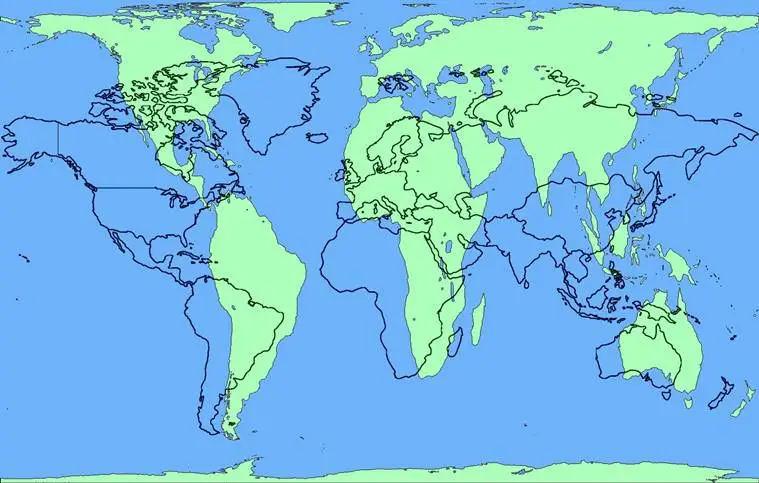
Image: Peters Projection Comparison Map
The suggestion feature is integral for moving through the architecture of Pinterest. While the search button is readily available and categories easily accessible to the user, this still involves a lot of sifting through content, in a way that isn’t conducive to the addictive pinning Pinterest is known for. Alternatively, suggestions allow for a curated experience that transports users effortlessly through space that, like the Arcades (CITE), create an artificial environment that streamlines the Pinterest experience. Suggestions appear after a pin is pinned, prompting the user with boards that contain that pin. Additionally, Pinterest also prioritises boards that share other pins that the user has already saved, to better reflect the interests and tastes of the user. Therefore, the more pins saved, the more accurate suggestions will be to the interests of the user. Following this, 'What begins as undifferentiated space becomes place as we get to know it better and endow it with value.' (Tuan, 1979, p. 6)
Because of the nature of the suggestion function, it isn’t long until each user (given they engage with the sit and amass more pins) carves out their own sense of place. Their suggestions at this point direct them towards a specific sort of content, creating their own sort of Pinterest map. Like a map, no one’s suggestions or content are the same. One user can involve themselves with beach images for holiday ideas, while another dedicates their Pinterest to fitness ‘tips and tricks’. However, both still exist in the same space. Each person’s experience is '… a purposeful selection from everything that is known, bent to the mapmaker's ends. Every map serves a purpose, Every map advances an interest.' (Woods, Kaiser, & Abramms, 2001, p. 4)
However, unlike a cartographer’s map, Pinterest maps can change and evolve. If I pinned classical art content, there is nothing preventing me from pinning physical education tools instead, altering the suggestions given to me. But regardless of their fluidity, ultimately, ‘different maps show different selections from what is available, in a medium where you cannot show everything at once.' (Woods et al., 2001, p. 8)
The suggestion function is an expert solution to navigating the dense visual space that is Pinterest. Its streamlined algorithm allows for easy construction of space, eradicating that anxiety that comes from being presented with such an overwhelming amount of content. From initially joining the site and stumbling through the search engine to easily drifting from board to board via suggestions, Pinterest seamlessly integrates the user into both its structure.
References
An Overlap of the Mercator and Peters Maps [Image]. Retrieved from http://images.indianexpress.com/2017/03/peters-projection-comparison-world-map-759.jpg
Prouty, R. (2009). On the Arcades Project. Retrieved from http://onewaystreet.typepad.com/one_way_street/2009/04/on-the-arcades-project.html
Shah, S. (2016). PINTEREST PUTS FORMER GOOGLE EXEC IN CHARGE OF RANKING ITS 75 BILLION PINS. Retrieved from https://www.digitaltrends.com/social-media/pinterest-hires-google-exec-engineering/
Tuan, Y. (1979). Introduction. Space and Place: The Perspective of Experience (3-7). London: Edward Arnold (Publishers) Ltd.
Woods, D., & Kaiser, W. L., & Abramms, B. (2001). The Multiple Truths of the Mappable World. Seeing Through Maps: Many Ways to See the World (1-12). Oxford: New Internationalist Publications™ Ltd.


No comments:
Post a Comment